
Zen and Japanese Empty Hand Martial Arts
About This Blog
Without philosophy,
the Martial Arts is just fighting.O’Sensei Richard Kim1
Japanese empty hand fighting arts migrated to the west after World War II, as service men returned from their tours of duty. Many of these men trained at karate dojos where they became physically proficient. But time, language, and cultural barriers meant that very few had the opportunity to learn the Zen philosophy that underpins the martial arts, thereby missing much of the essence of their art.
This blog seeks to address this by re-introducing Zen thought to martial artists. My goal is to help modern martial artists improve their understanding and practice of Japanese Empty Hand martial arts by helping them to better understand Zen and Zen’s influence on martial arts training.
Why?
I am a why person. Once I know how, I need to know why so I can get to the essence of the matter. I have been asking why since I first tied on a white belt back in 1970.
Many things in the martial arts are self-explanatory. Some things require time. Other things require an explanation from a good Sensei. And some things seem completely baffling. Over the years, I learned that all questions have answers. You just have to figure out where to look, or find the right person to ask.
Sooner or later, you will ask your Sensei a why question they either can’t or won’t answer. Rather than saying they don’t know, you might be told “Good question, just keep training and the answer will come to you”. Or they may offer an explanation that doesn’t stand up to scrutiny. Or they may give no answer at all.
At that point you are on your own…
To find the the best answer you must look in the right place. Often, the answers to martial arts questions do not lie within the martial arts.
The Shaolin Roots of Japanese Empty Hand Martial Arts
Martial artists in China, Okinawa, and Japan practised their arts within local societal, cultural and religious norms. It is generally accepted that modern Japanese empty-hand martial arts originated at the (Buddhist) Shaolin Temple (see my The Way of Shaolin blog post for more). Buddhism is also the most widely practised religion in Japanese society2 so most Japanese would be at least exposed to it, even if they don’t practice it.
So, to find the answers you are looking for, you may have to look there.
But that just raises more questions…
- Why would Zen Buddhist monks who practised a religion of altruism train in the martial arts?
- What were their outward physical goals and motivations?
- What were their inner goals and motivations?
- What was it about the fusion of Buddhism and the fighting arts that made Shaolin monks so effective?
Shaolin monks had a reputation as some of the most skilled martial artists who ever lived. This made me wonder—could modern western practitioners improve their martial arts understanding and skills by re-introducing Zen thought back into Japanese empty-hand martial arts?
My second Sensei, Sensei Dennis Farbatiuk (photo below), first introduced me to Zen in the early 1970’s. He would occasionally read Zen stories (books like The Ronin) and ask Zen koans like “What is the sound of one hand clapping?” after training. We would sit and discuss what he read and try to figure it out. And, we would mostly fail, because none of us had the Zen background to understand the message in the story.
This was made even more challenging because there is often no comparable view in Western culture or religion. We failed because we had no context we could use to even understand the question!
This lead me into a lifetime of inquiry and study into Buddhism, Zen and Japanese empty hand martial arts. This inquiry has yielded many practical answers.
This blog is about my sharing some of those answers.
About Me
Personal Details
- I have been studying the martial arts since 1970, and have 38+ years of study with senseis from many karate styles
- I hold a Nidan rank in Okinawan Goju
- I hold a Shodan rank Japanese / Canadian Goju
- I have trained in Shotokan and Koryu Uchinadi
- I have been an avid reader of Zen and Buddhist literature since I was a teenager
- In 2005, I finally found a fully qualified Buddhist teacher and began formal studies
My Qualifications
- I have no recognized qualifications in Buddhist studies
- I hold only junior Dan ranks in the martial arts
- I do not have endorsements from any senior Buddhist or martial arts teachers
- I am not a recognized teacher in either Karate or Buddhism
- I have earned no special recognition for my efforts
- I am a Buddhist lay practitioner
- I am a student (not an instructor) at my local dojo
And I like it that way.
Why? Because learning should never be about the teacher, it should always be about the teaching. If you find something profound, if it resonates with you or if it motivates you, dig into it. A teacher is just there to point the way. Teachers may come and go. But a lesson, once fully comprehended, internalized and put into practice, will stay with you forever.
I am not important. Likewise whatever qualifications, knowledge or skills I might possess are also unimportant. If I can point the way, illuminate an idea, or dispel a doubt, then I have fulfilled my purpose.
You must do your own work. Below is a teaching from The Buddha to help point the way by first explaining what to abandon, and then what to cultivate:
Kalama Sutta
The Buddha3
Do not believe in anything (simply)
because you have heard it.
Do not believe in traditions because they
have been handed down for many generations.
Do not believe in anything because it is
spoken and rumoured by many.
Do not believe anything (simply) because
it is found written in your religious books.
Do not believe in anything merely on the authority
of your teachers and elders.
But after observation and analysis,
when you find anything that agrees with reason
and is conducive to the good and benefit of one and all.
Then accept it and live up to it.
My Teachers
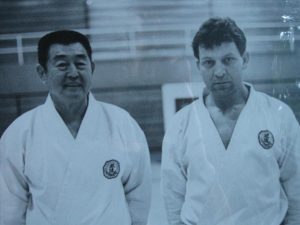
Sensei Dennis Farbatiuk.
(Undated photo from the 1970’s)
My Martial Arts Teachers
- Sensei Brian Reeves – Canadian / Japanese Goju. 1970-1973
- Sensei Dennis Farbatiuk – Shotokan. 1972-1973.
Sensei Farbatiuk was the first teacher to talk to me about Zen. - Sensei Scott Hogarth – Okinawan Goju. 1982-1984
- Sensei Nick Ribezzo – Shotokan. 1988-1991
- Sensei Brian Cyr – Canadian / Japanese Goju. 1991-2006
- Sensei Tony Rampulla – Koryu Uchinadi (Shotokan derived). 2014-2022
- Sensei Chris Englund – Okinawan Goju (IOGKF). 2018-2022
- Sensei Dushy Kandasamy – Okinawan Goju (IOGKF). 2022-present
(Undated photo from the early 2000’s)
My Buddhism Teachers
- Kelsang Sangdrub (my root teacher) in the New Kadampa Tradition (NKT). 2005-2022
- Kelsang Lochani. NKT. 2005-2022
- Kelsang Rigden. NKT. 2018-2021
- Kelsang Kunden. NKT. 2022-2024
About My Kind Teachers
I am grateful for all of my kind teachers who inspired me by showing me what was possible and the way to progress, by setting a positive example.
I am also grateful for all of my especially kind teachers who taught by negative example. In this way, they taught the unskillfulness of negative actions and the resultant needless suffering created by those actions, without my having to make those mistakes or experience that suffering myself. Through teaching by negative example, they taught that, before you can make progress, you must first learn what to abandon.
To those kind teachers who taught me by negative example, for your great kindness in taking suffering on yourself now, so that I might observe and use it open my eyes and learn, I am especially grateful.
When the environment and its inhabitants
overflow with unwholesomeness,
Transform adverse circumstances
into the path to enlightenment.
Geshe Chekawa4
This one short quote fully explains the essence of the path of a martial arts warrior.
Zensei

Peace
Notes
- Kim, Richard. was an American martial artist. He was an instructor of various disciplines, including Shōrinji-ryū Karate, Okinawan Kobudo, Daitō-ryū Aiki-jūjutsu, and Tai Chi. Kim was known for spreading traditional martial arts in North America and Europe.
Published by Wikipedia.org. Last updated April 8, 2026.
https://en.wikipedia.org/wiki/Richard_Kim_(karate) ↩︎ - Religion in Japan. Published by Wikipedia.org. Last updated March 26, 2026.
https://en.wikipedia.org/wiki/Religion_in_Japan ↩︎ - Anguttara Nikaya Vol 1, 188-193 P.T.S. Ed.
The Kalama Sutta starts on page 32. To download Volume 1 of the Anguttara Nikaya source text, please visit
https://static.sirimangalo.org/pdf/bpsanguttara1.pdf ↩︎ - Geshe Chekawa. Published by Wikipedia.org. Last updated March 20, 2026.
Geshe Chekhawa (or Chekawa Yeshe Dorje) (1102–1176) was a prolific Kadampa Buddhist meditation master who was the author of the celebrated root text Training the Mind in Seven Points, See verse 3 – Bringing Unfavourable Conditions Into The Path To Enlightenment
https://en.wikipedia.org/wiki/Chekawa_Yeshe_Dorje ↩︎