
In this article Sensei Mike explains the basic techniques of Training the Mind. He then explains how to combine Mind, Body and Intention training together into a single highly effective tool for resolving conflict.
This is part 3 of the 3-part origin story for my blog. Links to all three are below:
What Is The Point?
It was time for the adult class at Sensei Mike’s dojo to start. As he walked onto the floor, the senior student said in a strong, firm voice, “Shugo1”. As the newest student, Elliott took the junior position at the end of the line.
Sensei Mike then asked, “Any questions before we get started?”
Elliott hesitantly raised his hand. Sensei Mike nodded, “Elliott?”
Elliott said, “Excuse me, Sensei. I don’t understand. What is the point?”
“What don’t you understand?” Sensei Mike asked.
“Mokusō2.” Elliott said. “We do Mokusō at the beginning and end of every class, but I don’t know how to do it. I don’t even know why we do it. I’m here to learn self-defence. How does doing nothing help me become better at self-defence?”
Sensei Mike’s face lit up just a little, “Elliott, that is an excellent question!”. He then asked everyone to sit relaxed.
Sensei Mike continued, “To build your self-defence skills, you must train to overcome two major problems—I refer to them as your Outer and Inner problems3.”
Outer and Inner Problems
“Outer problems are anything in the physical world that you must overcome. Bullies are Outer problems. Your untrained body is an Outer problem. The techniques you need to defend yourself are Outer problems. Most dojos focus their training exclusively on solving Outer problems because they are easier to understand and teach. These dojos want you to believe that, if you train long enough and hard enough, you will be able to defend yourself.”
“But, there is a second of problem for which you must also train. You will understand this problem better if you ask yourself this question: ‘Am I mentally tough enough to overcome verbal and physical threats from a bully?’ If you answer no, or you have any doubts, this is your less obvious, but more significant Inner problem.”
“Inner problems are more significant because, even if you train your Outer problems for years, you may discover that, in a self-defence situation, you lack the mental fortitude to use your skills.”
“Inner problems are also less obvious, because we can’t just train by emulating them. We can observe people as they train physically—to see what they train, how they train, how often and how hard they train, and how they make it all work. But, how do you emulate a person who is engaged in training the mind? We may see the outward results of their mind training, as they remain calm, non-reactive, and highly effective in tense situations—but we have no way to see and emulate how they train to develop their mental skills, as we cannot look into the inner workings of their mind.”
Train Your Body
Sensei Mike continued, “When you join a dojo, the first thing you learn is how to develop, condition, and train your body. In time, you will build strength, flexibility, motor control, balance, and coordination. And, you will learn the biomechanics4 of basic techniques. As you progress, you will learn combinations, take downs, joint locks, pressure point strikes, balance displacement, and more. With enough body training, you may even feel that you could successfully defend yourself.”
“Body training can be highly effective, but it may not be sufficient to save you. This is because we assume that a bully will always bigger, stronger, faster, and more experienced than we are.”
“So, what else can we do to improve our chances?”
Training Technique
“We can improve our physical effectiveness by also training in technique. One of the founders of Brazilian Jujitsu, always told his students: ”
Always assume your opponent is going to be bigger, stronger, and faster than you so that you learn to rely on technique rather than on brute strength5.
Hélio Gracie
“When we add technique to our training, we learn, practice, and internalize the fine details of each move. For example, it is one thing to know how to strike. With technique, we also learn and practice where to strike, when to strike, the correct way to strike, how to use speed and power, balance and rooting, and so on, to maximum effect. Once you become proficient using technique, you will be able to avoid a slugfest-style6 fight that a street fighter or a boxer wants. Instead, a martial artist should be able to end a fight with a quick exchange of two or three skilfully delivered techniques.”
“When we combine Body training with Technique training, we dramatically improve our chances.”
“So, is this the best we can do? Or can we do even better?”
Train Your Mind
Sensei Mike continued, “We do Body and Technique training to counter a bully’s physical skills—but what can we do to overcome a bully’s mental skills? A bully’s mental toughness comes from experience using threats, anger, and hostility to intimidate their victims. When a bully starts a situation, they use verbal assaults, anger, aggression, and intimidation to win the mental fight that always comes first. If we have no defences against these, we will lose the mental fight, and possibly the physical fight. We need to learn how to overcome a bully’s mental skills, so that we prevail at the mental stage of a fight.”
Why Do We Hesitate?
“It is generally understood that an untrained person’s default reaction to danger and stress is fight-or-flight7. We do this because fight-or-flight is familiar to us. We’ve seen it, and maybe even done it—but it usually doesn’t work. It fails because we believe, and the bully believes, that they will win a physical fight. So, while we are trying to decide between fight or flight—we hesitate, because we: “
- “Think ‘Do I run? What if he catches me?’”
- “Think ‘Do I fight? What if I get hurt?'”
- “Tense up thinking, I don’t want to fight.”
- “Resist the situation thinking, This is unfair… what did I ever do to them?”
- “Stop paying attention, as we become overwhelmed with our thoughts and feelings.”
- “Panic, thinking, What if I get hurt?”
“And, in the time it takes for us to work through all of this, the bully could attack.”
“All of these unskillful responses, and the bully’s mental assault are our Inner problems. Inner problems are states of mind, that lead to unwanted outcomes. We can only rid ourselves of these responses when we recognize our Inner problems for what they are, and then train our mind to replace them with something more effective.”
Kihon Shin Waza
Sensei Mike continued. “In the East it is understood that, just as you can train your body, you can also train your mind. And, just as there are many techniques for training the body, there are also many techniques for training the mind.”
“But, there is a major difference between how you train your body and how you train your mind. When you start training your body, you want to add things like strength, stamina, power, and physical skills. But, when you start training your mind, you begin by abandoning things that don’t serve you, like you default fight-or-flight responses.”
So how do you do that?”
“In our tradition, there are many techniques for training the mind. But they all rely on five basic practices. These practices will help you to rid yourself of your fight-or-flight responses, and they will help you to, directly and indirectly, develop a calm, unshakable mind. In time, your well-trained mind will become your most powerful self-defence tool. Your calm, unshakable mind will help you win the mental fight, and if needed, the physical fight.”
The Five Techniques of Training the Mind
- “Presence – keeps you from retreating into your imagined past or future when you start thinking ‘Oh no, not this again.’ or ‘What if he does this or that?’. When you retreat into your past or future, you hesitate. Staying present in the here and now keeps you fully engaged in the situation.”
- “Relaxation – counters your natural tendency to tense up by helping you to release tension and remain calm. Holding tension wastes the energy you need to defend yourself. When you relax, that energy is available to you.”
- Acceptance – allows you to see the situation clearly and objectively exactly as it is. When you fully accept things as they are, you remain calm. You do that by abandoning your resistance, fears, judgments, feelings, and doubts. Once you abandon these, you can to respond skilfully and effectively to the situation.”
- “Awareness – also prevents you from retreating into your head. When you are fully aware, you remain focused on the situation as it unfolds, so you won’t be surprised or caught off guard. In time, you may even develop a sense of heightened awareness called Zanshin8.”
- “Breathing – is the foundation of all of our physical and mental practices. If you allow your breathing to falter, your practice of presence, relaxation, acceptance, and awareness will also falter. And, when your mind falters, your body falters. Breathing energizes your body and mind. It functions to release stress and develop power. Breathing is so fundamental to the martial arts that the karate style Gōjū-ryū9 (hard-soft style) incorporated the power of breathing into its name10.”
“All five techniques of training the mind are mutually supporting. For example, breathing energizes the body and helps you stay present. Presence and awareness work together to prevent distractions and keep you in the moment. Relaxation functions to overcome stress, anxiety, and resistance. Acceptance eliminates mental noise, like disturbing thoughts and feelings, so you stay alert and ready to respond skilfully.”
“I refer to these five basic mental practices as Kihon Shin Waza11. This is Japanese for the Basic Techniques of Training the Mind. These practices are so critical to our success as martial artists, that we practice them at the beginning and end of every class when we do Mokusō.”
“Our overall goal of this practice is to unify our Body and Mind training so that we attain a One Mind state—where our Mind, Body, and Intention work together as one. In this state, we see with clarity, act skilfully, and respond with strong intention. The Japanese name for this unified state of Body, Mind and Intention is Isshin (一心)12.”
The One Mind
“With our Isshin mind of clarity, we direct our body where to strike, when to strike, the correct way to strike, how to use speed and power, balance and rooting, and so on, to maximum effect by using the full force of our One Mind. Isshin makes your soft techniques faster and more fluid, and your hard techniques stronger and more powerful. In this way, Isshin works as a force multiplier13 because you achieve much more when your Body, Mind and Intention work in unison than you could achieve by using the Body, Mind or Intention individually.”
“Isshin gives a smaller, weaker person an advantage over a larger, stronger, and more powerful opponent. With it, you can win the mental fight by maintaining a state of calm non-reaction. If the fight turns physical, and you can’t avoid it, you will skilfully use your mind, body and strong intention to deliver a few effectively applied techniques that quickly end the fight.”
“All of this may sound good—but does it actually work? Consider… have you ever seen a much larger dog charge at a cat? What does the cat do? It usually just stands there and remains calm. It doesn’t react, and it doesn’t flinch. It rests in an Isshin like state of mind, ready to respond if necessary. In the majority of cases, it is the dog that flinches first and then backs down.”
Honouring Our Lineage
“Our tradition traces its lineage back to the Shaolin temple, where Mokusō was their primary form of spiritual practice.”
“Around 527AD, an Indian monk named Bodhidharma is said to have introduced martial arts training to the monastery as a way to enhance the monk’s practice of Training the Mind. The result was a powerful integration of Body and Mind—where a strong Body enhanced Mind training, and a strong Mind enhanced Body training. This union of Body, Mind, and Intention is the very essence of our martial arts practice.14”
This practice, when done diligently over many years, and with strong effort, is the pathway that will help us become the absolute best we can be.
Mokusō is Everywhere
“We train Mokusō with the overall goal of learning how to train our mind to relax, stay calm, and to clear and focus our mind. Once we have some experience with Mokusō, it will pervade all aspects of our training and our daily life. You have already seen Mokusō at the beginning and end of class. In time, you will see and begin to use brief Mokusō pauses: “
- “At the beginning and end of a kata”
- “In between kata template sequences”
- “Before, during and after sparring”
- “When practising self-defence drills”
- “During gradings”
- “When performing kata for a judge or an audience”
- “Wherever you feel stress.”
- “Between seeing and judging a situation.”
- “In almost all aspects of your daily life.”
“For some of you, this will be your first formal Mokusō lesson. When Mokusō is called, I want you to focus on your breath, because breathing is the most fundamental of the 5 basic Mind Training practices. Don’t try to change your breathing, and don’t allow your focus to wander away from your breath. It sounds simple. Lets try for just 5 minutes, and see how you do.”
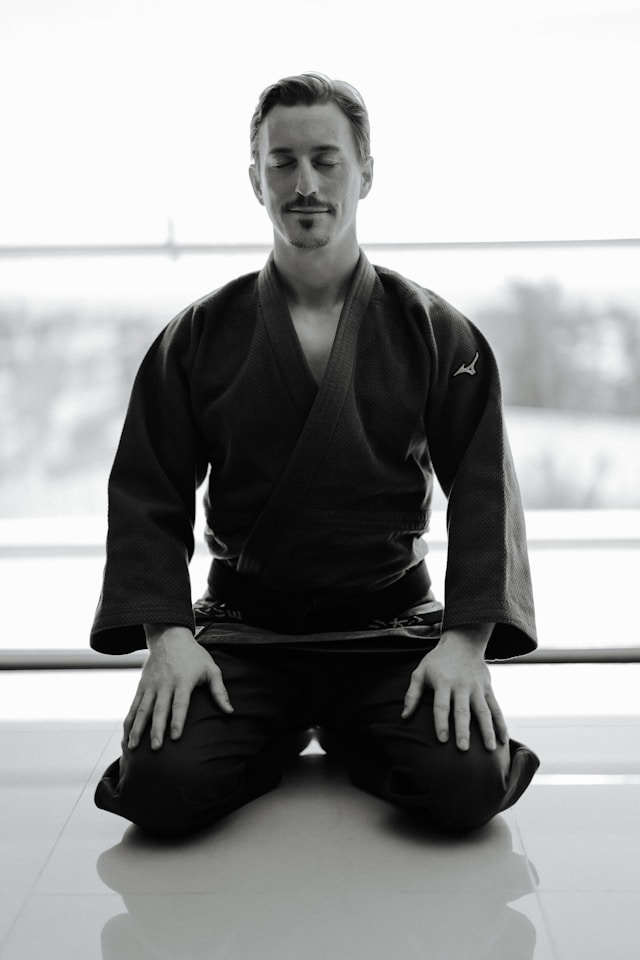
Sensei Mike then faced the class and sat down in the formal meditation posture. He nodded at the senior student, who responded with:
“Seiza” (please sit in the formal meditation posture)
“Mokusō” (meditate)
Zensei

Peace
Eastern Wisdom
As a fetcher straightens the arrow,
The Buddha15
so the man of understanding
makes straight the trembling unsteady mind,
which is difficult to guard and
difficult to restrain.
Whatever foe may do to foe,
The Buddha16
or hater to hater,
greater is the harm done (to oneself)
by a wrongly directed mind.
Neither mother nor father,
The Buddha17
nor any other relative,
can do one as much good
as a perfectly directed mind.
Dedication
For May – who was kind enough to ask how to train in a way that makes self-defence more effective.
Notes
- Nicola Higgins. The 7 most important phrases to learn in your first few classes.
Shugo – 集合 – assemble
Seiretsu – 整列 – line up
https://bristolshorinjikempo.org/2025/11/21/the-7-most-important-phrases-to-learn-in-your-first-few-classes/ ↩︎ - Martin Jutras. What is Meiso and Mokusō? Published 2024
Karate Meditation is a holistic practice that goes beyond physical training, deeply integrating the development of the mind and spirit.
Mokusō (Japanese 黙想 pronounced “moh-kso”).
https://www.thekaratelifestyle.com/what-is-meiso-and-mokuso/ ↩︎ - Inner and Outer Obstacles; Ways of Thinking
By Kyabje Lama Zopa Rinpoche Melbourne, Australia, 1991
https://www.lamayeshe.com/article/chapter/Inner-and-Outer-obstacles-ways-thinking ↩︎ - Biomechanics – the study of the structure, function, and motion of biological systems using the principles of mechanics.
Wikipedia.org. Updated February 12, 2026
https://en.wikipedia.org/wiki/Biomechanics ↩︎ - Hélio Gracie was one of the founders of Gracie Jujitsu, also known as Brazilian Jujitsu.
Wikipedia.org. Updated February 26, 2026
https://en.wikipedia.org/wiki/H%C3%A9lio_Gracie ↩︎ - Slugfest is a fight marked by an extended exchange of heavy blows.
https://www.merriam-webster.com/dictionary/slugfest ↩︎ - Cherry, Kendra. What is the Fight-or-Flight Response? Your body’s natural reaction to danger.
Updated Oct 14, 2025.
https://www.verywellmind.com/what-is-the-fight-or-flight-response-2795194 ↩︎ - Zanshin (Japanese: 残心) is a state of awareness and of relaxed alertness. A literal translation of zanshin is “remaining mind”. In karate, zanshin is the state of total awareness. It means being aware of one’s surroundings and enemies, while being prepared to react.
Wikipedia.org. Updated June 7, 2025
https://en.wikipedia.org/wiki/Zanshin ↩︎ - Gōjū-ryū (剛柔流). Japanese for hard-soft style. Published by Wikipedia.org. Edited April 6, 2026.
https://en.wikipedia.org/wiki/G%C5%8Dj%C5%AB-ry%C5%AB ↩︎ - Quast, Andreas. Eight Poems of the Fist. July 28, 2024.
Verse three reads: “Inhaling represents softness while exhaling characterizes hardness”
Extracts from:
McCarthy, Patrick (Hanshi). Bubishi. The Bible of Karate. Published by Charles E. Tuttle Company, Rutland Vermont & Tokyo Japan, 1995.
Miyazato Ei’ichi. Okinawa-den Gôjû Ryû Karate-dô. Jitsugyô no Sekaisha Kan, 1953, page 35.
Ôtsuka Tadahiko (translator). Okinawa-den Bubishi. Tôkyô, Bêsubôru Magajin-sha 1991.
Ôtsuka Tadahiko (translator). Chûgoku Ryûkyû Bugeishi. Tôkyô, Bêsubôru magajin-sha 1998, pp. 278 and 318 (identical).
https://isshin-concentration.blogspot.com/2024/07/8-poems-of-fist.html ↩︎ - Kihon – 基本 (basic), Shin – 心 (mind), Waza – 技 (technique). These are the five basic practices of training the mind. ↩︎
- Muscacchio, Fabrizio. Isshin: The undivided mind. August 7, 2025
Isshin (Japanese 一心), translates to “one mind” or “wholeheartedness”, expresses a quality of total engagement, sincerity, and undivided presence. In Zen practice, this state of mind is not merely about focus or intensity, but about bringing the full self — body, mind, and intention (shingitai) — into alignment with the activity at hand.
https://www.fabriziomusacchio.com/weekend_stories/told/2025/2025-08-07-isshin/ ↩︎ - Strategy Partners Group. Force Multiplier is a factor or an attribute that dramatically increases the effectiveness or productivity of a resource or activity, producing an output that is greater than the inputs. Originally, it was used as a military term to describe strategies or tools that significantly enhance combat effectiveness.
Published April 23, 2025
https://strategypg.com/what-is-a-force-multiplier/ ↩︎ - Zensei.info. The Way of Shaolin. Blog post published August 23, 2024
All Karate clubs will help you train your body. But, to become truly proficient, you must also train your mind and spirit. In this post, Sensei Mike explains the most effective way to train.
https://zensei.info/the-way-of-shaolin/ ↩︎ - Sangharakshita (translator), The Dhammapada: The Way of Truth. Verse 33, Windhorse Publications,
https://archive.org/download/dhammapadathewayoftruthsangharakshita_783_G/Dhammapada%20The%20Way%20of%20Truth%20Sangharakshita.pdf ↩︎ - Sangharakshita (translator), The Dhammapada: The Way of Truth. Verse 42, Windhorse Publications,
https://archive.org/download/dhammapadathewayoftruthsangharakshita_783_G/Dhammapada%20The%20Way%20of%20Truth%20Sangharakshita.pdf ↩︎ - Sangharakshita (translator), The Dhammapada: The Way of Truth. Verse 43, Windhorse Publications,
https://archive.org/download/dhammapadathewayoftruthsangharakshita_783_G/Dhammapada%20The%20Way%20of%20Truth%20Sangharakshita.pdf ↩︎