
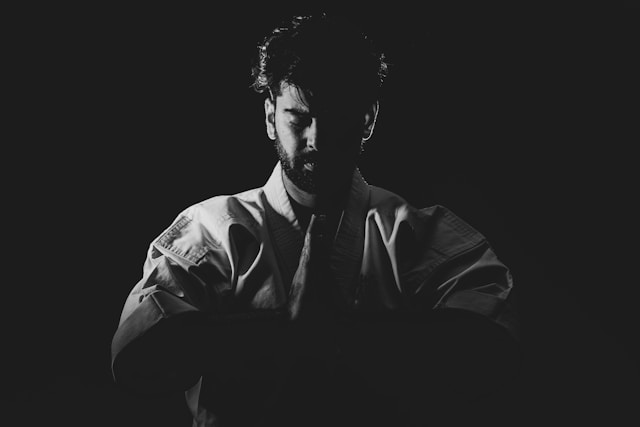
This is the last of the 3-part origin story for my blog. Links to all three are below:
What Is The Point?
It was time for the adult class at Sensei Mike’s dojo to start. As he walked onto the floor, the senior student said in a strong, firm voice, “Shugo1”. As the newest student, Elliott took the junior position at the end of the line.
Sensei Mike then asked, “Any questions before we get started?”
Elliott hesitantly raised his hand. Sensei Mike nodded, “Elliott?”
Elliott said, “Excuse me, Sensei. I don’t understand. What is the point?”
“What don’t you understand?” Sensei Mike asked.
“Mokusō2.” Elliott said. “We do Mokusō at the beginning and end of every class, but I don’t know how to do it, or even why we do it. I’m here to learn self-defense. How does doing nothing help me become better at self-defense?”
Sensei Mike’s face lit up, “Elliott, that is an excellent question!”. He then asked everyone to sit relaxed.
The Importance of Training the Mind
Sensei Mike then then said “Mokusō (training the Mind) is the most important training you’ll ever do in traditional Japanese empty hand martial arts. How do we know? We know because Mokusō comes first!”
“Traditional Japanese society is very hierarchical—the most important people are always acknowledged first. For example, at the start of class we bow to our lineage founder and our lineage masters first. Then we bow to our instructor.”
“But before we bow to anyone, we do Mokusō. Why is this?”
“We practice Mokusō first because it helps us to get the most out of everything we do after Mokusō. When we practice Mokusō, we learn how to calm our mind, to relax, and to be fully present. We may do short Mokusō pauses during stressful training. And, we do a final Mokusō at the end of class to review our performance, and to consider how we can do even better,”
Sensei Mike continued, “There is a truism that says In life, it’s not just what you’ve got, but what you do with what you’ve got that counts. This applies to the martial arts and to Mokusō. When you do Mokusō unskillfully, you waste your time and get no benefit. When you do Mokusō skillfully, it accelerates your training, and it can improve your life. Let me explain this in the context of self-defence…”
Outer and Inner Problems
“To build your self-defence skills, you must train to overcome two major problems. I refer to these as your Outer and Inner problems3.”
Outer Problems
“Outer problems are anything in the physical world that you must overcome to achieve your goals. Bullies are Outer problems. Your untrained body is an Outer problem. The techniques you need to learn to defend yourself are Outer problems. Most dojos focus their training on Outer problems because Outer problems are easier to understand, teach and learn. These dojos want you to believe that, if you train your Outer problems long enough and hard enough, you will be able to defend yourself.”
Inner Problems
“But there’s a second kind of problem you also need to address. You will understand this better if you ask yourself this question: ‘Am I mentally tough enough to withstand a bully’s verbal and physical attacks?‘ If your answer is no, or you have any doubts, that is your less obvious but more significant Inner problem.”
“Inner problems are more significant because, even if you train your Outer problems for years, you may lack the mental toughness to use your skills.”
“Inner problems are also less obvious, because we can’t simply train by emulating them. We can observe people as they train their Outer problems—to see what they train, how they train, how often and how hard they train, and how they make it all work. But, there is no outward way to emulate a person who is engaged in Inner training. We may see the outward results of Inner problem training, as they remain calm, non-reactive, and highly effective in a tense situation. But we have no way to see and emulate how they train their Inner problems, because we cannot look into the inner workings of their mind.”
Start By Training Your Body
Sensei Mike continued, “When you join a dojo, the first thing you do is to start training your Outer problems by learning how to develop, condition, and train your body. In time, you will build strength, flexibility, fine motor control, balance, and coordination. And, you will learn the biomechanics4 of basic techniques. As you progress, you will learn combinations, take downs, joint locks, pressure point strikes, balance displacement, and more. With enough Body training, you may eventually feel that you can successfully defend yourself.”
“With just Body training alone, you may become skilled, but it may not be enough to save you in a self-defence situation. Why? Because we train assuming that an adversary will always be bigger, stronger, faster, and more experienced than we are.”
“So, what can we do to improve our chances?”
Add Technique
Sensei Mike continued, “We can improve our effectiveness by training technique. Hélio Gracie, one of the founders of Brazilian Jujitsu, always told his students: ”
Always assume your opponent is going to be bigger, stronger, and faster than you so that you learn to rely on technique rather than on brute strength5.
“When we add technique to our training, we learn, practice, and internalize the fine details of each move. For example, it is one thing to know how to strike. By adding technique, we also learn and practice where to strike, when to strike, the correct way to strike, how to use speed and power, balance and rooting, and so on, to maximum effect. Once you become proficient using technique, you will be able to avoid a slugfest-style6 fight that a street fighter or a boxer wants. Instead, as a martial artist, you should be able to end a fight with a quick exchange of two or three skillfully delivered techniques.”
“When we combine Body training with Technique training, we dramatically improve our chances of success.”
“So, is this the best we can do? Or can we do even better.”
How To Train Your Mind
Sensei Mike continued, “We do Body and Technique training to counter a bully’s physical skills, but what can we do to overcome a bully’s mental skills? A bully’s mental toughness comes from their experience using threats, anger, and hostility to intimidate and dominate their victims. When a bully starts a situation, they use verbal assaults to win the mental fight that always comes before a physical fight. If we have no defences against verbal attacks, we will lose the mental fight, and likely the physical fight that follows. To succeed, we need to learn how prevail at the mental stage of a fight.”
Why Do We Hesitate?
“For most people, the default reaction to danger and stress is freeze-fight-or-flight7. We do this because freeze-fight-or-flight is familiar to us. We’ve seen it, and maybe even done it—but it usually doesn’t work. It fails because we believe, and the bully believes, that they will win a physical fight. So, while we are trying to decide between freeze, fight or flight, we hesitate, as we: “
- “Think ‘Do I run? What if he catches me?’”
- “Think ‘Do I fight? I might get hurt.'”
- “Tense up thinking, ‘I don’t want to fight.’”
- “Resist the situation thinking, ‘This is unfair… what did I ever do to them?’”
- “Stop paying attention, as we become overwhelmed with our thoughts and feelings.”
- “May panic, thinking, Why is this happening to me?”
“And, in the time it takes for us to work through all of this, we could get badly hurt.”
“All of these unskillful thoughts, and the bully’s mental assaults are our Inner problems. Inner problems are states of mind, that lead us to unwanted outcomes. We can only rid ourselves of these responses when we recognize our Inner problems for what they are and then train our mind to replace them with something that actually works.”
What to Abandon and What to Train
Sensei Mike continued. “In the East it is understood that, just as we can train our body, we can also train our mind 8. And, just as there are techniques for training the body, there are also techniques for training the mind.”
“There is a major difference between how we train our body and how we train our mind. When we start training our body, we work to build strength, stamina, power, and physical skills. But, when we start training our mind, we start by learning how to abandon our default habit patterns that don’t serve us, including our default freeze-fight-or-flight responses. We do this to make room in our mind so that we can begin training new mental responses that serve us.”
So how do we do that?”
“In our tradition, there are many techniques for training the mind. But they all rely on five basic practices. These practices will help us to rid ourselves of our freeze-fight-or-flight responses, and they help us to develop a calm, unshakable mind. In time, our well-trained mind will become our most powerful self-defence tool. Our calm, unshakable mind will help us win the mental fight, and if needed, the physical fight.”
Five Basic Techniques for Training the Mind
The five basic techniques for training the Mind are:
- “Presence – keeps us from retreating into our imagined past or future when we start thinking ‘What did I ever do to him?’ or ‘What if I can’t defend myself and he hurts me?’. When we retreat into our past or future, we hesitate. Staying in the present moment keeps us fully engaged in the situation as it unfolds.”
- “Patience – counters our natural tendency to tense up. When we practice patience, we relax, release stress, and remain calm. Holding tension wastes exactly the energy we need to defend ourselves. When we relax, that energy is available to us to use as we choose.”
- Acceptance – allows us to see the situation clearly and objectively exactly as it is. When we fully accept things as they are, we remain calm. We do that by abandoning our resistance, fears, judgments, feelings, and doubts. Once we have abandon these, we can to respond skillfully and effectively to a situation.”
- “Awareness – prevents us from letting our mind wander. When we are fully aware, we remain focused on the situation as it unfolds, so we won’t be surprised or caught off guard. In time, we may even develop a sense of heightened awareness called Zanshin9.”
- “Breathing – is the foundation of all of our physical and mental practices. If we allow our breathing to falter, our practice of presence, patience, acceptance, and awareness also falters. And, when our mind falters, our body falters. Breathing energizes our body and mind. It functions to release stress and develop power. Breathing is so fundamental to the martial arts that the karate style Gōjū-ryū10 (hard-soft style) incorporates the power of breathing into its name11.”
Kihon Shin Waza
“All five techniques of training the mind are mutually supporting. For example, breathing energizes the body and helps us to stay present. Presence and awareness work together to prevent distractions and keep us in the moment. Patience and acceptance functions to overcome stress, anxiety, and resistance. Acceptance helps us to relax. It also functions to eliminate mental noise, like disturbing thoughts and feelings, so we stay alert and ready to respond skillfully.”
“I refer to the five basic Mind training techniques as Kihon Shin Waza12. This is Japanese for the Basic Techniques of Training the Mind. By practising these mental techniques, we begin the process of abandoning our default freeze-fight-or-flight responses, and start cultivating a calm, non-reactive mind. These practices are so crucial to our success as martial artists, that we do formal Mind training (Mokusō) at the beginning and end of every class.”
One Mind
“Our longer term goal is to unify our training so that we attain a One Mind state—where our Mind, Body, and Intention13 work together as one. In this state, we see with clarity, act skillfully, and respond instantly with our indomitable spirit. The Japanese name for this unified state of Body, Mind and Intention is Isshin (一心)14.”
“With our Isshin mind of clarity, we direct our body exactly where to strike, when to strike, the correct way to strike, how to use speed and power, balance and rooting, and so on, to maximum effect by using the full force of our One Mind. Isshin makes our soft techniques faster and more fluid, and our hard techniques stronger and more powerful. In this way, Isshin works as a force multiplier15 because we are much more effective when our Body, Mind and Spirit work in unison than we could ever achieve by using our Body, Mind or Spirit individually.”
In the modern world, a martial artist practising the Isshin mind could be described as being in the Flow—a state of full involvement, energized focus and with full commitment to the task at hand16.
The Self-Defence Advantage
“Isshin gives a smaller, less powerful person an advantage over a larger, and stronger opponent. With it, we first win the mental fight by maintaining a state of calm non-reaction. If the fight turns physical, and we can’t avoid it, we skillfully use our Mind, Body and indomitable Spirit to deliver a few effectively applied techniques that quickly end the fight.”
“All of this sounds good—but does it actually work? Consider… Have you ever seen a much larger dog charge a cat? What does the cat usually do? It just stands there and remains calm and alert. It doesn’t react, and it doesn’t flinch. Instead, the cat rests in an Isshin like state of complete awareness. In most cases, it is the dog that flinches and backs down.”
“So, is this the best we can do, or can we do even better?”
How To Train Your Spirit
“As I said in a previous talk17, your Body, Mind and Spirit are the three tools a martial artist must develop to their full potential.”
“We use Spirit to commit ourselves fully to whatever action we undertake. When we use Spirit in self-defence, we engage our adversary not just with our Mind and Body, but also with all of our energy, our strong intentions, our emotions, and with the full expression of our art. As a past teacher once told me: “
It isn’t the size of the dog in the fight,
It is the size of the fight in the dog.18Hanshi Patrick McCarthy
“When we commit to an action with Spirit, we: “
- “Fully commit to the action with no hesitation, no reservations, no half measures, and no excuses—no matter what.”
- “Engage our Body fully, relying on it to respond instantly and naturally.”
- “Use the power of our Mind to remain calm and non-reactive, so that we can see and act with clarity and skill.”
- “Apply the sum total of our physical, mental and spirit energy into our actions.”
- “Use emotions to feel and experience the engagement.”
The ultimate goal of Spirit training is to develop an immovable mind. That is, a mind that, once set, cannot be moved from its course of action. This is also called an immovable heart or unmoving heart. The Japanese term for this mind is Fudōshin (不動心)19.
Add Emotional Content
“It is easy to experience strong emotions in a stressful situation. We need to skillfully channel our emotions into our actions to achieve the outcome we desire for all involved. As Bruce Lee said: “
“We need emotional content, not anger!20“
“Anger is never the way21, because anger’s only purpose is to harm ourselves and others.”
“When we are able to protect ourselves and others, and with a mind motivated by compassion, and even use our skill to protect our adversary from needless harm, we have found the true way of Not Fighting. The deep desire to do no harm is the essence of our art and the highest level of martial arts maturity. The union of our strong Body, Mind, and indomitable Spirit is the supreme tool we use to walk the path of peace—the path of Not Fighting22.”
Our Mind Training Lineage
“Our tradition traces its lineage back to the Shaolin temple, where Mokusō was their primary form of spiritual practice.”
“Around 527AD, an Indian monk named Bodhidharma is said to have introduced martial arts training to the monastery as a way to enhance the monk’s practice of Training the Mind. The effect was the full integration of Body, Mind and Spirit training; where a strong Body is developed in dependence upon a strong Mind and Spirit, a strong Mind is developed in dependence upon strong Spirit and Body, and an indomitable Spirit is developed in dependence upon a strong Body and Mind. This union of Body, Mind, and Spirit is the ultimate goal of our martial arts practice.”
Mokusō is Everywhere
“The monks at the Shaolin temple practiced basic meditation techniques including presence, acceptance, patience, awareness and breathing to calm their mind23 before formal meditation training. Likewise, we train the same five mental techniques during Mokusō, at the beginning of class, to clear and focus our mind so that we can fully immerse ourselves into our training. We train Mokusō at the end of class to review and internalize what we learned, to evaluate our performance, and to contemplate ways to improve.”
“Once we know why we do Mokusō, and we have some experience doing it, we may find ways to apply Mokusō during our training, and to our daily life-such as: “
- “At the beginning and end of a kata”
- “In between kata template sequences”
- “Before, during and after sparring practice”
- “When practicing self-defense drills”
- “During gradings”
- “When performing kata for a judge or an audience”
- “Wherever we are feeling stressed”
- “In the instant between seeing a situation arise, but before we judge it, so that we stay calm and fully in the moment.”
- “In almost all aspects of your daily life.”
How to Practice Mokusō
“Whenever we experience stress, when we are unsure what to do, or when we need to calm and re-centre our mind to observe, think clearly, and respond skillfully, we should take a short Mokusō break. Sometimes, a Mokusō pause of just a few seconds is all we need.”
“In time, we will become a Mokusō expert. The peace, calmness, and clarity that Mokusō provides will enhance our training, and our daily life.”
“Our Mokusō training starts now. When Mokusō is called, I want you to focus on your breath, but don’t try to change it. Do your best to hold your awareness on your breath without forcing it. We’ll try it for one minute to see how you do.”
Sensei Mike then sat down in the formal meditation posture. He nodded at the senior student, who responded with:
“Seiza” (please sit in the formal meditation posture)
“Mokusō” (meditate)
Zensei

Peace
Epilogue – The Peaceful Warrior
Most martial artists are familiar with the oral traditions of the skilled Shaolin fighting monks. Many books and movies have been created about the adventures of wandering mendicant monks who protect the masses from local war lords, criminals and bullies.
These stories of wandering itinerant monks protecting peasants are so common in China that they are referred to as Rivers and Lakes stories24 (as transport often involved water travel). In the modern world, they are often called Eastern Westerns. In North America, this genre first appeared in 1972 and sparked a 2+ year martial arts craze after the launch of the TV series Kung Fu. This series tells the story of a Shaolin Monk wandering through southwest USA in the 1800s in search of a lost family member. While these stories may be entertaining, they usually downplay the monk’s mind and spirit skills, and tend to focus mostly on the monk’s martial arts skills.
The Six Perfections of Mahayana Buddhism
In reality, Shaolin monks practiced Mahayana25 and Vajrayana Buddhism. The main texts of Mahayana Buddhism are the Lotus Sutra, and the Perfection of Wisdom sutras26 including the Heart Sutra. The very essence of the Perfection of Wisdom sutras are the study and practice of the Six Perfections, including the Perfections of:
- Giving – without expectation of reward through the motivation of altruism
- Moral Discipline – By adhering to moral principles that are consistent with the Dharma
- Patience – To willingly and patiently accept and endure the truth of life’s challenges
- Effort – To commit to the pursuit of enlightenment through patient, persistent effort
- Meditation – practicing mindfulness and concentration to develop calm inner peace and insight
- Wisdom – By realizing the ultimate nature of reality, including emptiness and impermanence of all things
These practices help to lead a monk toward the goal the of enlightenment for the benefit of all beings.
The Six Perfections of a Peaceful Warrior
The Five Techniques of Training the Mind are the foundation of eastern meditative practice. Any martial artist who wants to train on the path of peace should practice the Five Techniques of Training the Mind and the Six Perfections. This can be done from a secular, martial arts perspective, as follows:
- Giving – By using their martial arts skills to give protection from harm to themselves and others
- Moral Discipline – By doing no harm to others, and by preventing others from doing harm to themselves or others
- Patience – By patiently enduring harm from others without retaliating, and by protecting themselves and others from receiving serious harm. This is why a martial artist on the path of peace train to end a fight rather than fighting to win
- Effort – By continuously exerting strong effort in training their mind, body and spirit so as to build their skill far beyond what a mere fighter could achieve
- Meditation – By practising Mokusō (meditation) as a pathway to train their mind through the martial arts. This would involve using techniques like visualizations including performing and refining drills in their head, by using imagination to contemplate losing a fight to motivate them to train harder, and by developing the compassionate wish to protect all suffering beings
- Wisdom – By understanding that people have no choice but to endure the sufferings of human existence. Through the practice of Six Perfections combined with their martial arts skills, a martial artist develops compassion for all beings and willingly takes on the responsibility to help reduce suffering for themselves and others through their knowledge, skills, abilities and wisdom.
In this way a martial artist trains on the path of peace.
These are the ideals that Sensei Mike demonstrates in his dojo. He honours and upholds the values and commitments of his tradition by exemplifying them, and by passing them down to the next generation of martial artists.
Eastern Wisdom
As a fetcher straightens the arrow,
The Buddha27
so the man of understanding
makes straight the trembling unsteady mind,
which is difficult to guard and
difficult to restrain.
Whatever foe may do to foe,
The Buddha28
or hater to hater,
greater is the harm done (to oneself)
by a wrongly directed mind.
Neither mother nor father,
The Buddha29
nor any other relative,
can do one as much good
as a perfectly directed mind.
Holding on to anger
is like grasping hot coal
used to throw at another.
You are the one who is burned.Buddhaghoṣa30
Dedication
This blog post is dedicated to May – who was kind enough to ask how to train in a way that makes self-defense more practical and effective.
Notes
- Higgins, Nicola. The 7 most important phrases to learn in your first few classes.
Shugo – 集合 – assemble
Seiretsu – 整列 – line up
https://bristolshorinjikempo.org/2025/11/21/the-7-most-important-phrases-to-learn-in-your-first-few-classes/ ↩︎ - Jutras, Martin. What is Meiso and Mokusō? Published 2024
Karate Meditation is a holistic practice that goes beyond physical training, deeply integrating the development of the mind and spirit.
Mokusō (Japanese 黙想 pronounced “moh-kso”).
https://www.thekaratelifestyle.com/what-is-meiso-and-mokuso/ ↩︎ - Inner and Outer Obstacles; Ways of Thinking
By Kyabje Lama Zopa Rinpoche Melbourne, Australia, 1991
https://www.lamayeshe.com/article/chapter/Inner-and-Outer-obstacles-ways-thinking ↩︎ - Biomechanics – the study of the structure, function, and motion of biological systems using the principles of mechanics.
Wikipedia.org. Updated February 12, 2026
https://en.wikipedia.org/wiki/Biomechanics ↩︎ - Hélio Gracie was one of the founders of Gracie Jujitsu, also known as Brazilian Jujitsu.
Wikipedia.org. Updated February 26, 2026
https://en.wikipedia.org/wiki/H%C3%A9lio_Gracie ↩︎ - Slugfest is a fight marked by an extended exchange of heavy blows.
https://www.merriam-webster.com/dictionary/slugfest ↩︎ - Cherry, Kendra. What is the Fight-or-Flight Response? Your body’s natural reaction to danger.
Updated Oct 14, 2025.
https://www.verywellmind.com/what-is-the-fight-or-flight-response-2795194 ↩︎ - Lief, Judy The Why and How of Lojong, or Mind Training. The teachings on mind training, or Lojong, are an invaluable aid to practitioners because they show us how the wisdom and skillful means of the Mahayana can actually be put into action. They show us how to make it real.
https://www.lionsroar.com/lojong-mind-training-teachings/ ↩︎ - Zanshin (Japanese: 残心) is a state of awareness and of relaxed alertness. A literal translation of zanshin is “remaining mind”. In karate, zanshin is the state of total awareness. It means being aware of one’s surroundings and enemies, while being prepared to react.
Wikipedia.org. Updated June 7, 2025
https://en.wikipedia.org/wiki/Zanshin ↩︎ - Gōjū-ryū (剛柔流). Japanese for hard-soft style. Published by Wikipedia.org. Edited April 6, 2026.
https://en.wikipedia.org/wiki/G%C5%8Dj%C5%AB-ry%C5%AB ↩︎ - Quast, Andreas. Eight Poems of the Fist. July 28, 2024.
Verse three of this poem reads: Inhaling represents softness while exhaling characterizes hardness.
Paraphrased from his blog post which reads ‘Chôjun, Miyagi Sensei chose this term as the name of his style from the Chinese book called Wubèizhì (Bubishi in Japanese). This book represented the written tradition of the southern Chinese branch of Shaolin-boxing called White Crane Gate’.
Extracts from this article include:
McCarthy, Patrick (Hanshi). Bubishi. The Bible of Karate. Published by Charles E. Tuttle Company, Rutland Vermont & Tokyo Japan, 1995.
Miyazato Ei’ichi. Okinawa-den Gôjû Ryû Karate-dô. Jitsugyô no Sekaisha Kan, 1953, page 35.
Ôtsuka Tadahiko (translator). Okinawa-den Bubishi. Tôkyô, Bêsubôru Magajin-sha 1991.
Ôtsuka Tadahiko (translator). Chûgoku Ryûkyû Bugeishi. Tôkyô, Bêsubôru magajin-sha 1998, pp. 278 and 318 (identical).
https://isshin-concentration.blogspot.com/2024/07/8-poems-of-fist.html ↩︎ - Kihon – 基本 (basic), Shin – 心 (mind), Waza – 技 (technique). These are the five basic practices of training the mind. ↩︎
- In this context, I treat Intention and Spirit as synonyms. Fabrizio Muscacchio, the author of the Isshin article (item 13 below) uses the word intention together with body and mind. For this reason, I repeat his use of the word intention in this paragraph.
For the rest of my article, I revert back to the more traditionally accepted body, mind, spirit when referring to the three tools of a martial artist. ↩︎ - Muscacchio, Fabrizio. Isshin: The undivided mind. August 7, 2025
Isshin (Japanese 一心), translates to “one mind” or “wholeheartedness”, expresses a quality of total engagement, sincerity, and undivided presence. In Zen practice, this state of mind is not merely about focus or intensity, but about bringing the full self — body, mind, and intention (shingitai) — into alignment with the activity at hand.
https://www.fabriziomusacchio.com/weekend_stories/told/2025/2025-08-07-isshin/ ↩︎ - Strategy Partners Group. Force Multiplier is a factor or an attribute that dramatically increases the effectiveness or productivity of a resource or activity, producing an output that is greater than the inputs. Originally, it was used as a military term to describe strategies or tools that significantly enhance combat effectiveness.
Published April 23, 2025
https://strategypg.com/what-is-a-force-multiplier/ ↩︎ - Flow State. A mental state where a person experiences complete focus and full commitment, while being fully immersed in a task.
Published by Wikipedia.org. Last edited June 25, 2026.
https://en.wikipedia.org/wiki/Flow_(psychology) ↩︎ - Zensei.info. The Way of Shaolin. Blog post published October 23, 2024
All Karate clubs will help you train your body. But, to become truly proficient, you must also train your mind and spirit. In this post, Sensei Mike explains the most effective way to train.
https://zensei.info/the-way-of-shaolin/three-tools-of-a-martial-artist ↩︎ - Exploring the True Meaning of the “It’s Not the Fight in the Dog” Quote. Published by Befagi. February, 2026
https://life.befagi.com/exploring-the-true-meaning-of-the-its-not-the-fight-in-the-dog-quote/ ↩︎ - Fudōshin (不動心), or the Mind of Fudō Myōō, is a state of inner peace and unshakable determination that can arise in martial artists who is absolutely intent on single-mindedly achieving their goal. Fudōshin is also referred to as an immovable mind, an immovable heart, or an unmoving heart. This is a mental skill originally found in Buddhist Mahayana traditions that advanced Japanese martial artists use to improve their effectiveness.
Fudō Myōō is a Shingon Buddhist guardian deity that is also the patron of Japanese martial arts.
Published by Wikipedia.org. Last edited October 13, 2025.
https://en.wikipedia.org/wiki/Fud%C5%8Dshin ↩︎ - Lee, Bruce. Quote from the 1973 move “Enter the Dragon” ↩︎
- Rahman, Saidur . Anger in Buddhism (Things You Need to Know). Published by Budding Buddhist
Anger in Buddhism is considered a mental state that causes a powerful physical reaction. Buddhism holds that anger is responsible for many unwholesome actions. It creates an obstacle to developing loving-kindness and compassion.
https://buddingbuddhist.com/anger-in-buddhism/ ↩︎ - Zensei.info. When the Student is Ready. Blog post published Dec 20, 2024.
https://zensei.info/when-the-student-is-ready/the-way-of-not-fighting ↩︎ - Andersen, Reb (Tenshin). Entering the Mind of the Buddha – Zen and the Six Heroic Practices of Bodhisattvas.
Shambala Publications. Published December 17, 2019. Extract from the chapter titled Radiant Presence
https://www.shambhala.com/perfection-of-patience-radiant-presence/ ↩︎ - Shahar, Meir. “The Shaolin Monastery – History, Religion, and the Chinese Martial Arts.” University of Hawai’i Press. 2008. Page 67. ↩︎
- Rony, Jon. Mahayana Buddhism: The Great Vehicle of Compassion and Wisdom. Created June 3, 2025. Latest edit November 10, 2025 ↩︎
- The Perfection of Wisdom sutras are Mahayana Buddhist texts where The Buddha teaches his view of Ultimate Reality. There are at least 3 versions of this sutra, including:
The Large Perfection of Wisdom Sutra in 18,000 Lines (free download)
The Perfection of Wisdom Sutra in 8,000 Lines (free download), and
The Heart Sutra – The Essence of the Perfection of Wisdom (free download). ↩︎ - Sangharakshita (translator), The Dhammapada: The Way of Truth. Verse 33, Windhorse Publications,
https://archive.org/download/dhammapadathewayoftruthsangharakshita_783_G/Dhammapada%20The%20Way%20of%20Truth%20Sangharakshita.pdf ↩︎ - Sangharakshita (translator), The Dhammapada: The Way of Truth. Verse 42, Windhorse Publications,
https://archive.org/download/dhammapadathewayoftruthsangharakshita_783_G/Dhammapada%20The%20Way%20of%20Truth%20Sangharakshita.pdf ↩︎ - Sangharakshita (translator), The Dhammapada: The Way of Truth. Verse 43, Windhorse Publications,
https://archive.org/download/dhammapadathewayoftruthsangharakshita_783_G/Dhammapada%20The%20Way%20of%20Truth%20Sangharakshita.pdf ↩︎ - Buddhaghoṣa, The Visuddhimagga (The Path of Purification)
https://quoteinvestigator.com/2018/06/18/hot/ ↩︎